The Josephine
Mariners' Museum, Uncurated Search Results
Type: Schooner
Year: 1890
Builder: J. S. Beacham & Bro.
Location: Baltimore
These records are found in the online catalog of The Mariners’ Museum and Park in Newport News, Virginia. Uncurated search results are presented to give researchers and interested readers an idea of whether the museum’s archives contain information about this vessel and whether it may be worthwhile to visit the museum’s catalog search page for further investigation. Uncurated results may be inaccurate or incomplete.
Search mode: Exact Name. Search phrase(s): "The Josephine". Results returned: 10. Results displayed in this table: 10.
Use these buttons to send uncurated search results to your own app or text document for further research. First, check the box for any row, or click "Select All" then uncheck any rows. Then click "Show Selections". You can then copy your selections from the text box and past them into your app.
| Fetch? | Row ID | Media | Date | Vessel | Place | Related Places | Inscription/Marks | Subject | Notes | Archive Number |
|---|---|---|---|---|---|---|---|---|---|---|
| 1 | No image URL. | The Josephine | P0001.011/01-2915 | |||||||
| 2 | 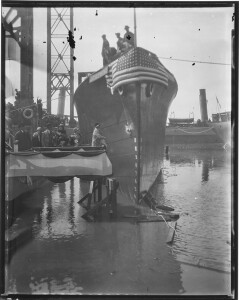 | 1926 | Josephine (Yacht : 1926).; Newport News Shipbuilding and Dry Dock Company. | Yachts–Launching.; Yachts–Virginia–Newport News. | Bow view of the yacht Josephine during its christening when the bottle is breaking against the side of the ship. The launching party is standing on a platform next to the ship. | MS0228/01-#0526 | ||||
| 3 | No image URL. | New York (Side wheel steamer : 1837).; Josephine (Side wheel steamer : 1867).; Morgan's Louisiana and Texas Railroad and Steamship Company | Shipwrecks–Mexico, Gulf of. | Written by Jack B. Irion and David A. Ball. | LB98566 | |||||
| 4 |  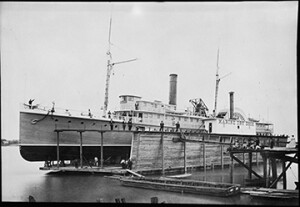 | NOTES: These models came to the museum when the goverment took over the Morgan Line ships for use in the war. At this time, the Southern Pacific Co., abandoned its services and donated models of their ships. ADDITIONAL INFORMATION: Excerpt from article: The New York and the Josephine: two steamships of the Charles Morgan Line; By Jack B. Irion and David A. Ball; The International Journal of Nautical Archaeology (2001) 30.1: 48-56 By 1867, Morgan’s interests were once again well established along the Gulf Coast, and in that year he contracted Harlan and Hollingsworth to construct the Josephine. This ship was built specifically for his Louisiana and Texas Railroad and Steamship Company. Completed in early 1868, the Josephine first arrived at New Orleans on 29 February, 1868, having departed from Wilmington, Delaware 23 days earlier. The vessel made stops in Havana, Cuba, and Key West, Florida, along the way. Among the passengers on her maiden voyage were Charles Morgan and several members of his family. A contemporary account described the vessel as ‘. . . the most beautiful and elegant of any that have entered the port of Havana’ (Daily Picayune, 1868). The account continues by describing the vessel as having two cabins, an 800-horsepower engine, and being able to accommodate 250 passengers. At the time of the Josephine’s construction, Harlan and Hollingsworth had already earned a reputation for constructing quality iron-hull vessels (Hall, 1884: 204). The company first began building ships around 1844 and is credited with constructing two of the first iron-hulled merchant ships in the United States, the Ashland and the Ocean. In 1883 they built the first steel-hull vessel, the Olympian. In 1906 the company became part of the Bethlehem Steel Corporation (Pearson & Simmons, 1995: 65). From 1856 to 1860 Harlan and Hollingsworth constructed four steamships for Charles Morgan (Baughman, 1968: 107). Each of these ships included a single vertical walking beam engine and a compartmentalized hull. As a result of Morgan’s satisfaction with these vessels, Harlan and Hollingsworth eventually built 28 ships for the Morgan Line (Gause, 1886). Upon arrival in the Crescent City, the Josephine was assigned to run a new route from Brashear City, Louisiana (later renamed Morgan City in honour of Charles Morgan) to Galveston, Texas. In addition to carrying passengers and freight, the Josephine also served as a mail carrier between these cities. According to newspaper advertisements, the Josephine ran this route twice a week. At least three events recorded in local newspapers during the Josephine’s run between Louisiana and Texas are worth mentioning here. Shortly after beginning service along the Gulf Coast in 1868, the steamer was almost lost when she ran aground at Brazos Bar, off the Texas coast. After almost two weeks she was removed from the bar, taken back to New Orleans, and placed in dry dock at the Vallette Dry Dock facility. A copy of the marine surveyor’s report, dated April 15, 1868, testified to the durability of this vessel: ‘as far as we can discover, not a single rivet has been started, and not a single drop of water came out of any part of her bottom’. This grounding apparently had little effect on the steamer, other than allowing people the opportunity to see the underside of the vessel, as the account continues by saying: ‘It is the intention of Mr Morgan to allow his noble vessel to remain in the dock during to-day (Saturday), in order that those of our citizens who feel so inclined may have an opportunity of observing her out of water’. A contemporary photograph of the Josephine in dry dock may have been made to immortalize this occasion (Fig. 6-see image attached to computer record). In 1874 there was an account of the Josephine transporting the entire New Orleans Mechanic’s Fire Company, No. 6, along with their steam engine, to Galveston and back, charged at standard excursion rates. This event is significant only because it is symbolic of yet another major industry made possible by the regular and predictable schedules of the steam packets . . . tourism. The following year, 1875, the Josephine functioned as a refuge vessel for the people of Corpus Christi, Texas, when Mexican bandits raided the town. This serves as a reminder that, even then, sightseeing was not without risk. On January 15, 1881, the Josephine was transferred to the New Orleans to Havana route, replacing the steamer Morgan, another vessel built by Harlan and Hollingsworth of Wilmington, Delaware. This was to be her last excursion. The Josephine departed New Orleans on January 27 and arrived in Havana several days later. She departed Havana with a cargo of tobacco and cigars (Irion, 1989: S), as well as several passengers. Among the passengers was a family of musicians led by Professor Herman Franko. According to a contemporary account of the foundering, the steamer began her return trip to New Orleans at 5p.m. on 2 February. She arrived in Key West the following afternoon and departed for Cedar Key that evening, arriving on the morning of Friday the 4th. At Cedar Key the Josephine picked up several more passengers. Included among the new passengers were 14 members of an Italian crew that had recently survived the sinking of their lumber ship, originally bound for London from Pensacola. The Josephine left Cedar Key around 4p.m. Friday, en route to New Orleans, apparently sailing without incident until sometime Sunday when it was noticed that the vessel was leaking. Passengers and crew worked to bail water but could not control the leak. Therefore, arrangements were made to abandon ship that evening. However, the leak began to subside, until the seas picked up and then the vessel began to take on water once more. By Monday evening, the Captain had the crew again prepared to abandon ship and by 3 a.m. on Tuesday morning all had escaped, and the vessel began to heel. According to another account of the sinking, the Josephine ran into a hurricane sometime Saturday afternoon; it did not let up until Monday. ‘On Sunday morning it was discovered that the pressure of the water against the side of the ship opened the seams and the water was pouring in at a fearful rate’ (Daily Picayune, 10 February, 1881). This incident was reported as the first serious accident to a Morgan Line vessel in 11 years. The loss of the Josephine was valued at $75,000. Although it was described as a hurricane by one of the survivors, the time of the foundering was in early February, well after the hurricane season ends on the Gulf Coast. Nevertheless, it must have been a very severe winter storm, for several accounts of storm damage were detailed in the same edition of the Daily Picayune; most of the buildings at Pass Manchac were destroyed and damage also was incurred as far east as Pensacola, Florida. Archival research on the Josephine has identified her registration number as 13806 (Lytle, 1952: 103). Recorded dimensions for the vessel are 235 ft long, 34 ft beam, and 18 ft 6 in. depth of hold (71.6 x 10.3 x 56m) and weight 1283 tons. Advertised as a low-pressure steamship, she was powered by a 50-inch diameter engine with an 11-foot stroke. The Morgan Iron Works Company supplied the engine. Josephine had a round stern, two decks, and two masts. As mentioned previously, the ship included two cabins and could hold up to 250 passengers (Hall, 1884: 211; Gause, 1886: 382). VESSEL INFORMATION-- VESSEL NAME: JOSEPHINE VESSEL TYPE: Iron hull side wheel steamboat SERVICE DATES: 1867 SHIP BUILDER: Harlan & Hollingsworth Co. BUILDER LOCATION: Delaware, Wilmington VESSEL HISTORY: Contained beam engine, 50" diameter, 11' stroke SHIP OWNERS: Charles Morgan VESSEL DIMENSIONS: 1283 gross tons; 235' x 34' x 18'6" | CL54 | |||||||
| 5 | No image URL. | NOTES: Lantern attributed to the New Bedford whaler JOSEPHINE. The JOSEPHINE disappears from the U.S. Register after 1909 so it is not very likely that this lantern came from that ship. Traces of original red paint around raised areas. | CL9522 | |||||||
| 6 | 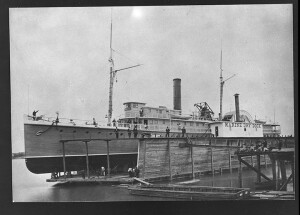 | 1867-1881 | Josephine (Side wheel steamer : 1867). | Josephine - 1867/Southern Pacific | Broadside of the Josephine at dry dock. | MS0091/03.01-29#034 | ||||
| 7 | 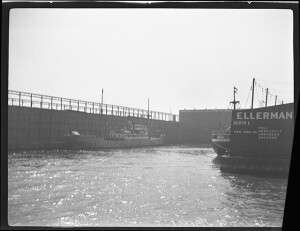 | 5/10/1936 | Ships.; Harbors.; Piers. | Rear-quarter view of the Josephine Maersk docked at a pier. This vessel name has not been verified. | MS0091/03.01-75#143 | |||||
| 8 | 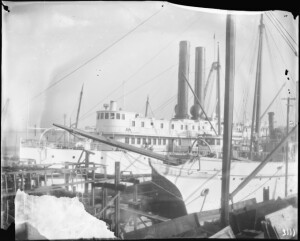 | 1/27/1901 | Augusta (Steamship : 1900).; Eaglet (Steamboat : 1884).; Josephine (Yacht : 1895). | Augusta - Eaglet - Josephine; 3111 | Steamboats–Pennsylvania–Philadelphia.; Steam yachts–Pennsylvania–Philadelphia. | In the foreground shows the bowsprit of the Josephine with the Augusta in the background, the pilothouse of Eaglet can just be seen between them. Stanton's notebooks contain the following information about this item: "Jan 27, 1901 Phila" | MS0094/01-#3111 | |||
| 9 |  | 1926 | Josephine (Yacht : 1926).; Savarona (Yacht : 1926).; Newport News Shipbuilding and Dry Dock Company. | Ships–Launching.; Yachts–Virginia–Newport News.; Crowds–Virginia–Newport News.; Shipyards–Virginia–Newport News. | A crowd gathered to watch the launching of the Josephine, Savarona, and a third unidentified ship. The original panoramic negative was digitized. | MS0228/02-#37 | ||||
| 10 |  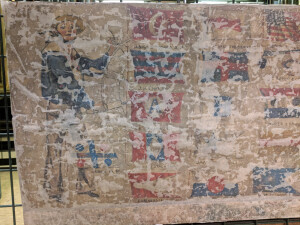 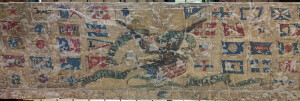 | SHORT DESCRIPTION: Oil painted board covered with white canvas. Sailors stand at either end of the board each holding the spokes of a large steering wheel. There is a large eagle with wings spread over a United States shield. A banner in his beak reads "Private Signals of the Merchants of Boston, Mass. NOTES: Before the advent of the electric telegraph, a system of flag signals was in use, the merchants of Boston having a set of one hundred and twelve private signals, each one a different flag. When a ship arrived, the owner's color was run up at Hull, repeated on an island in the harbor, again shown on Central Wharf, and finally at the old State House. NOTES: The painting appears to be severely overpainted as some of the merchants names are spelled incorrectly. There are photographs in the object file which seem to show the painting undergoing some sort of "restoration" in the shipyard's model shop in the 1930s or 1940s. The painting was faced with tissue and varnish in the 1970s to try and hold the painted surface together. It has remained that way ever since. This may be the original painting from which the well-known lithograph by Kramer & Co. was created from. There are some mistakes in the rendering of the signal flags that may be attributed to the heavy overpaint. For example: in column 7 a rectangular flag with a yellow field and blue dot has no name underneath (T. S. Davis & Co.) and in column 8 the Higgins & Co. flag is portrayed as a rectangular shape with white field and blue dot when its supposed to show a swallowtail shape with white field and blue dot. NOTES: For references below see object file. Iasici, Goddard, & Co. is also spelled Iasigi or Jasigi. The partners were Joseph Jasigi and Thomas A. Goddard. From Joseph’s 1897 obituary, he came to Boston from Armenia in 1830 and formed the partnership. His son, Joseph Andrew Jasigi, was born in 1848 and eventually became a partner. Joseph Andrew went on to be a consul general to Turkey but was arrested for embezzling $220,000, for which he spent 12 years in prison. J. H. Cheney operated in the 1840s and 1850s as a merchant and ship broker. By 1855 he had offices at 4 India wharf. Larkin & Stackpole Co. - Charles Larkin and David D. Stackpole (1811-1879) started the company in 1852 and continued until 1877 when it became Larkin & Cutting with Andrew Cutting. F. Nickerson & Co was Fred W. Nickerson (1808-1879), the company name became F.W. Nickerson & Co. after Fred died. F.W. Nickerson included Frederick W. Nickerson, Alfred A. Nickerson, and Elkanan C. Crosby but their company failed in 1886 after their ship, City of Columbus, sank. Blanchard, Sherman & Co. included Alfred Blanchard, Elisha Sherman, and George Baker. They were in business as commission merchants from the 1840s to mid-1860s. Sampson & Tappan were George R. Sampson and Lewis W. Tappan. They were co-owners of the Stag Hound with George B. Upton, which was an extreme clipper built by Donald MacKay. One of their New York representatives was Vernon H. Brown who later worked for Cunard Steam Ship Company. One of the largest shipowners in Boston. N. & B. Goddard - Nathaniel Goddard had an office at 24 Union wharf in 1836 but failed before Panic of 1857. W. M. Ropes & Co. - William H. Ropes and Joseph S. Ropes had offices at 36 India wharf 1848. They had relocated to 25 Lewis wharf by 1855 but by then the partners were William H. Hardy and Joseph S. Ropes. The company was still in business there in 1862 with William Ropes, Hardy Ropes, and Joseph S. Ropes as partners. Homer & Sprague - Richard T. Sprague and Charles Homer appear in the papers as early as 1843. They had offices at 36 India wharf by 1855 and were still there by 1872. Page, Richardson & Co. dissolved in 1875. Dabney & Cunningham - Frederic Cunningham (1826-1864) and his cousin, Charles William Dabney, Jr. started the company in 1848 but closed when Cunningham died. Their offices were at 59 Commercial wharf and they owned the ships Harbinger, Pomona, Grampus, Melita, Io, Mermaid, Lotos, Azor, and Fredonia. A. Cunningham & Sons started in 1822 as A. & C. Cunningham (Andrew & Charles) but Charles retired in 1849 so Andrew's sons, James Henry Cunningham and Charles West Cunningham became partners and the name changed to A. Cunningham & Sons. Charles' son, Frederick, helped start Dabney & Cunningham above. Crowell, Lewis & Co. was Joseph D. Crowell, William H. Lewis, and George T. Lovell. They were ship chandlers at 120 Commercial wharf in 1852, and also appear in the 1872 city directory. Zadoc C. Crowell was a senior partner when he died in 1887. E. Atkins was Elisha Atkins, he started working with William F. Freeman in 1838 as Atkins & Freeman, but went into business alone in 1849 until 1866 when John W. Cummings became a partner and the company became Atkins & Co. Elisha died in 1888 but Atkins' son and grandson eventually joined the company as late as 1915. Baker & Morrill was Ezra H. Baker and Charles J. Morrill. The company started in 1840s as Baker & Hardy with Alpheus Hardy. When Morrill worked his way up from bookkeeper to partner in 1845 the name changed to Hardy, Baker, & Morrill. When Hardy retired the name became Baker & Morrill. They owned the ship Southern Cross, built in 1851. Daniel Draper & Son - Daniel (1788-1867), by 1855 William Perkins Draper was in control with offices at 20 S. Market. A.C. Hersey was Alfred C. Hersey (1804-1888), a merchant at 67 Commercial wharf by 1855. His obituary states, he "was the largest owner and wharfinger of Commercial wharf for 25 years,” and he was also a partial owner in at least 40 different vessels. Charles S. Brown & Co. were commercial merchants at 11 Custom House Street in 1855 city directory. By 1857 and again in 1858 they are at 28 India Wharf. Geo. M. Barnard was George M. Barnard, who appears in the papers as early as the 1840s. He had offices at 41 Commercial wharf by 1855, and in 1866 contributed money toward the purchase of a school ship, it was sold in 1872. John H. Foster & Co. were grain merchants but the company was suspended in 1880. Howes & Crowell - Osborn Howes was born in 1806, started the company with his brother-in-law, the company lasted 34 years. Ships included the Josephine, George Hallett, Newton, and Osborn Howes. 1855 city directory has Osborn Howes and Nathan Crowell as commercial merchants at 65 Commercial wharf. J. H. Shattuck & Co. - Alfred B. Warren, Francis A. Osborn were ship chandlers at 4 Commercial Wharf in 1855 city directory. Warren died in 1881. Matthew Cobb appears in the papers in the early 1840s. By 1855 he had offices at 4 Central wharf, and in 1858 a ship he owned, Serampore, was lost off Cohasset in a snow storm but all hands survived. Henry Gardner (1809-1890) was a merchant in the 1830s and 1840s who owned the ship Hazard, bark Henry, and schooner Renown, and others. Sprague, Soule & Co. - They sold plaster as early as 1839, and by 1848 the partners were William Sprague, George M. Soule, and Edward Whitney with offices at 7 T wharf. By 1855 the partners were George M. Soule, Edward Whitney, and Alfred Winsor, dealers in plaster and grindstones. They helped start what became the Boston & Philadelphia Steamship Company, running it under their name until 1873. Henry Winsor died in 1889 and Alfred Winsor became president. Tow Boat R. B. Forbes was named for Captain Robert Bennet Forbes. The tug was built in 1845 by Otis Tufts, the first with an iron hull to be built in Boston. It helped ships move from the New England shipyards to New York to finish the fitting out process and was sold several times until the U.S. Navy purchased her in 1861. She ran aground in a storm off Cape Henry on February 25, 1862, and was lost. Perrin & Gilbert – Franklin Perrin and Benjamin W. Gilbert were commission merchants at 49 Central Wharf in 1855 city directory. H. P. Oxnard – Henry P. Oxnard was a merchant at 19 India in 1855 city directory Crowell, Brooks & Co. – Henry G. Crowell and H.C. Brooks with S.M. Hunt at 37 and 38 Commercial Wharf in 1855 city directory. George B. Upton born in 1804, was shipowner, ship designer, and politician. Listed as merchant in 1855 city directory at City Exchange and a house at 56 Bowdoin. Involved in shipping, whaling, railroads, died in July 1874. Prince & Baker – Richard M. Baker and Samuel Prince were sailmakers at 22 India Wharf in 1855 city directory David Snow & Co. were commercial merchants. In 1853 they owned the ship Reporter, by 1855 they had offices at 1 Commerce, and in 1874 when Otis wharf caught fire their fish wharf burned as well. G. T. & W. P. Lyman - George Theodore Lyman and William Pratt Lyman were merchants at 97 State Street. The company failed in Panic of 1857. J. S. Coolidge & Co. - Joseph S. Coolidge worked with George H. MacKay from 1833-1850, then started his own firm. The partners were John Templeton Coolidge, Joseph S. Coolidge, Jr., and John Templeton Coolidge, Jr. They owned ship Nor’wester in 1855, also owned Versailles, Atlas, Annie Buckram, and R.B. Forbes. By 1855 the partners were A.C. Slater and John Templeton Coolidge, Jr. Seccomb & Taylor started as Seccomb, Bartlett, & Co. who were commission merchants at 31 and 32 Commercial wharf in 1845; the partners then were E. Seccomb, C.L. Bartlett, and E.R. Seccomb. By 1852 the company had become Seccomb & Taylor, with Captain Isaac Taylor involved. They built ships and sold them rather than operating the ships themselves. The company owned the Winged Racer, Swallow, Queen of Clippers, Red Jacket, Blue Jacket, and Springbok. By the 1870s Charles L. Bartlett ran a firm called C.L. Bartlett & Co., but whether it was the same company or something separate is unknown. He died in 1883. Hill, Sears & Co. - Hamilton A. Hill and Eben Sears were commission and forwarding merchants at 21 Commercial wharf in 1855 directory. They were taxed in 1856, by 1857 they were at 69 Commercial Wharf. A large fire in 1851 destroyed their paint stuffs. B. C. Clark & Co. - Benjamin C. Clark & Co. operated from 1830-1848, owned Sea Eagle, Water Witch, Silenus, Red Rover, Sea Mew, he built and owned schooner Mermaid the first decked yacht in Boston, and built Raven which won the first regatta cup sailed in Massachusetts Bay in 1845. Fisher & Co. Eben S. Fisher, Francis Fisher, Francis K. Fisher, and J.B. Robinson were commercial merchants at 23 Central Wharf in 1855 directory. By 1866 directory the firm was Eben S. Fisher, Edward P. Fisher, Emery P. Fisher, Francis Fisher, Francis K. Fisher, John H. Fisher were commercial merchants at 23 Central Wharf. E. D. Brigham & Co. - Elijah D. Brigham & Co. existed by 1846 with offices at 1 Long wharf with Joseph L. Brigham. By 1855 the partners were J.S. Brigham and Joseph L. Brigham, but the company (flour merchants) failed in the Panic of 1857. An 1859 advertisement has J.S. Brigham working with Thayer, Brigham, & Field and next to Brigham's name is (late E.D. Brigham & Co.). Vernon Brown & Son (see Sampson & Tappan above) - shipbrokers at 5 Merchant Exchange. Vernon H. Brown became the agent for Cunard Steam Ship Line. Wm. Appleton & Co. - William Appleton started the company and Samuel Hooper joined him in 1842. Samuel Hooper, F. Gordon Dexter, John H. Reed were merchants with this company at 35 and 36 Lewis Wharf in 1848 and still in 1855. They were part owners of the Ocean Monarch with Enoch Train & Co. and R.G. Shaw & Co. Wheelwright & Cobb – Josiah Wheelwright and Samuel C. Cobb in 1855 directory as commission merchants at 47 Central Wharf W. A. Harris – William A. Harris was a merchant and agent at 7 Rowe’s wharf in 1855 directory Isaac Rich & Co. - Isaac Rich (1801-1872) was in the fish business and one of the founders of Boston University. By 1855 the partners were Aaron B. Vannevar, Orien E. Downing, Thomas A. Rich, Edward S. Dane at 35 Commercial. The company was at the same address in 1872, but by 1889 they were in debt and hoping for an extension on the repayments. Thomas A. Rich had been in the fish business since at least 1849. B. Burgess & Sons appears in the newspapers from 1840-1881. Benjamin Burgess, Nathan B. Gibbs and Benjamin F. Burgess were commission merchants at 38 India Wharf, but the company failed in 1881. Chas. B. Fessenden is in the papers in 1842, was a commission merchant at 134 State in 1855 directory. The 1879 directory has him working as part of Fessenden, Russell, & Co. Williams & Daland – Henry T. Daland and Henry L. Williams were merchants at 33 Lewis Wharf in 1855 directory. Firm dissolved in 1862. Trull Brothers were distillers Ezra Trull and John P. Tarbell, they had a fire in 1838 when the vapors from the liquor caught fire. They existed at 50 Merrimac between 1851 and 1855. By 1859 they added Alexander Sidi to the firm and offices had moved to 42 Court. There was another fire in 1857 and the company failed in 1858 but Daniel Emery Chase (who had started working there in 1852) took over for the year until he partnered with Ezra Trull & Co. to eventually become Chase & Trull by late 1860s or early 1870s. Pierce & Bacon - George Bacon, Thomas Pierce partnered in 1845, grocers who began trading. In 1851 they partnered with Andrew Pierce and he joined in 1852. Dissolved in 1865. Magoun & Son - Thatcher Magoun and Thatcher Magoun Jr. were merchants at 66 State in the 1855 directory. Magoun started the company in 1833, but when he died in 1856 at age 81 his son and grandson carried on with same company name until dissolved in 1877. They had more than 60 ships at one time. He was a ship designer, builder, and merchant and built many of his own ships. W. & F.H. Whittmore & Co. - sometimes spelled Whitmore Alpheus Hardy & Co. - Alpheus Hardy and Ezra Baker worked together in the 1840s along the coast then extended to the Mediterranean. Never lost a ship to the Confederates in the Civil War. Hardy died in 1887 so his son, Alpheus H. Hardy, took over. Thomas Lamb - President of New England National Bank of Boston, daughter was Emily Goddard Lamb who married Gustavus Tuckerman, Jr. in 1851 (see Tuckerman, Townsend & Co. below). E. Gassett & Co. - Edward Gassett & Co. were merchants at 67 Commercial Wharf with Edward R. Hall in 1855 directory. Owned clipper ship Mermaid. Lombard & Co. - Ephraim Lombard was a commission merchant who started the company in 1827 and operated from 13 Lewis wharf by 1838, by 1851 they were running packets to Charleston, SC. They were the original co-owners of ships Moneynick (1854), Edisto (1851), and Seabird (1851). The company was still in existence when his son, Ephraim Lombard, Jr. died in 1916 but the offices had moved to South Boston by that year. R.C. MacKay is Robert Caldwell MacKay, a ship owner who worked with J.S. Coolidge between 1833 and 1850 at 16 Union wharf, and continued his offices there through the mid 1850s. He owned property on Beacon Street. A.S. & W.C. Lewis - Should be A.S. & W.G. Lewis for Abiel Smith Lewis and William Gustavus Lewis. They were commission merchants at 53 Commercial wharf. They possibly worked as druggists for a time in the 1840s, but by 1872 the company operated from 7 Rowes Wharf with Charles Dudley Lewis. Enoch Train & Co. – Train Line (White Diamond Line) of packets to Liverpool started in 1844, Enoch worked with his uncle Samuel Train earlier. Located at 37 Lewis Wharf, then around 1852 he bought Constitution Wharf with his private offices on State Street. After he died in 1868 the company became Thayer & Warren, then Warren & Co. Glidden & Williams began in 1849 with William T. Glidden and John M.S. Williams; by 1852 John A. Glidden had become a partner and the company had started a line of packets to San Francisco. They were merchants at 29 Lewis wharf by 1855 but the company dissolved in 1877. Possibly related to the current Glidden paint company. Rush & Wildes - should be Bush & Wildes. Moses B. Wildes and James P. Bush were commission merchants at 20 India Wharf in 1855 directory and owned the ship Whistler. They appear in books in 1837 and again in 1860. Later the company may have become Bush & Comstock. Curtis & Peabody - Francis Curtis and S. Endicott Peabody were merchants at 40 India Wharf in 1855 directory. Suffered during panic of 1857 but appear in directory of 1870 at 40 State. E. Weston & Son was Ezra Weston who started the company E. Weston in 1763. His son, Ezra Weston II became a partner in 1798 and the name became E. Weston & Son, then full owner when his father passed away in 1822 and the name returned to E. Weston. Ezra Weston II's sons took over the company when he died in 1842 and the name became E. Weston & Sons. The sons were Gershom Bradford Weston, Alden Bradford Weston, and Ezra Weston IV. Their offices were on Commercial wharf, but the company closed in 1857. John M. Mayor & Co. - should be John M. Mayo & Co. were merchants at 5 India Wharf in 1855 directory. Crocker & Sturgis - James Sturgis and Henry H. Crocker were merchants at 80 State in the 1855 city directory, but had worked with Crocker & Warren of New York since the 1840s. Reed & Wade - Reuben S. Wade and Samuel G. Reed, appear in papers by 1846 and then merchants at 16 North Market in 1855 directory. Owned steamer Argo at one time. A. T. Hall - Andrew T. Hall, died November 1875 from obituary in The Boston Globe, 23 November 1875: He was 77, worked with brother Samuel and John T. Wells in company, became largest importers of crockery and glassware in the country. Firm dissolved in 1847, owned ships, supported Enoch Train’s “famous line of packets.” George C. Lord was born in Kennebunk, Maine in 1823 and moved to Boston in 1843. He formed the company in 1850 with his brother and they became ship builders and owners. They launched ship Josephus in 1850 from Kennebunk, and later owned bark Wild Hunter that was dismasted while at sea in 1882. Charles H. Lord was listed as a partner in 1855 and George C. Lord died in 1893. Bush & Comstock were agents for Pacific Mail Steamship Company in 1862. S. C. Thwing & Co. - 1877 obituary says Supply C. Thwing was born 1798 and died 1877, formed partnership in 1831 with Stephen H. Perkins, Perkins retired in 1844 so Thwing partnered a few days later with Richard Sullivan to form S.C. Thwing & Co. Sullivan retired in 1867 when E.B. Townsend and John Thomas joined the partnership. They were merchants who owned vessels, worked in coal trade. T. B. Wales & Co. - The 1832 city directory has the company as a partnership between Nathaniel H. Emmons and Thomas B. Wales Jr. at Wales wharf. From Emmons’ 1878 obituary, he joined the company as a boy in the counting room and worked his way up to become a partner. He married a Wales daughter. By 1855 George W. Wales had joined Emmons as a partner at 50 Central wharf. Cunningham Bro’s started by two nephews of Andrew and Charles Cunningham (see above), John A. Cunningham and Loring Cunningham Tuckerman, Townsend & Co. - Gustavus Tuckerman Jr. was born in England in 1824. He represented Curtis & Greenough and made partner after 1849. He married Emily Goddard Lamb, daughter of Thomas Lamb (see above), in 1851. Around then Alfred Greenough died so Tuckerman Jr. partnered with Thomas D. Townsend to create the firm. Company dissolved in 1859 because of bad trading economy with India. N. Winsor Junr & C. - Nathaniel Winsor Jr. & Co. was run by Aaron Sargent Jr, a commercial merchant in 1855 directory. | CL12612 |
Created 2026 by Don Barker, CBMM volunteer, for the Chesapeake Shipbuilding Project. shipbuilding@sailingworkboats.es